Knowledge Kastle
Education with passion

Education with passion
Education with passion
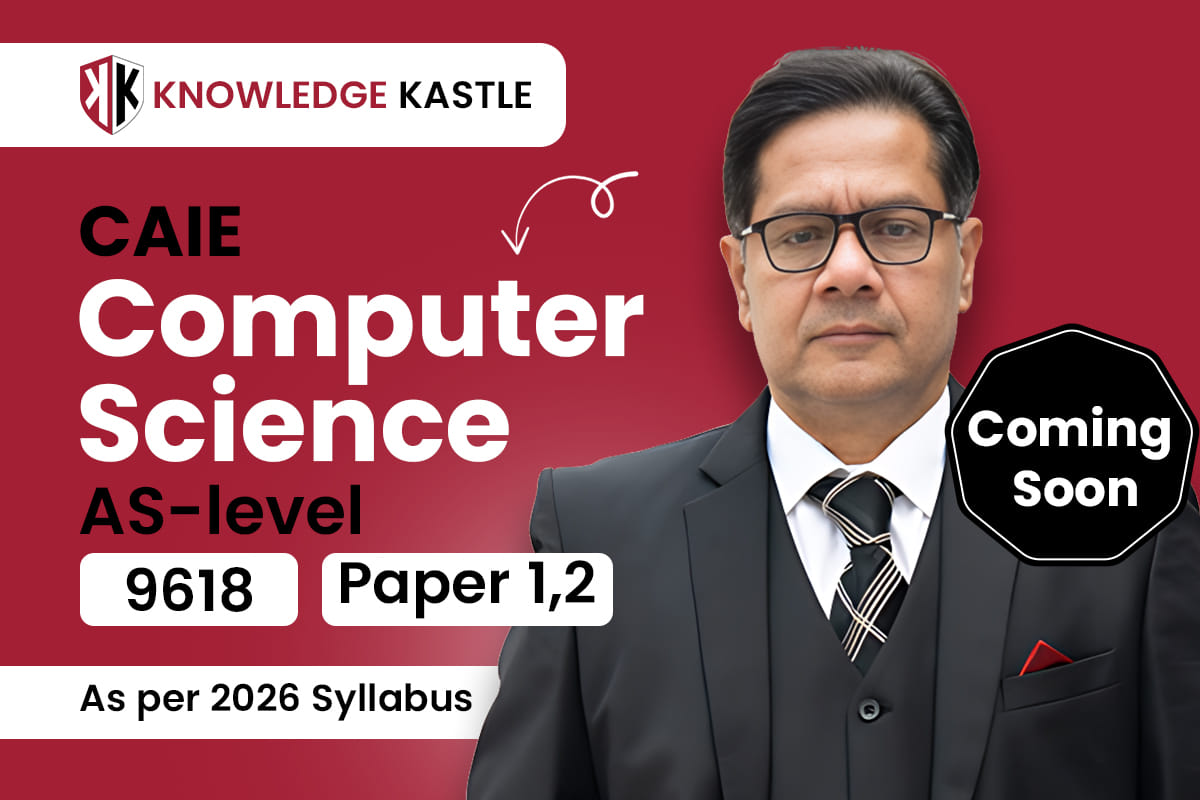
The Cambridge International AS Level Computer Science (9618) syllabus develops a deeper understanding of computational thinking, programming, and computer systems. At AS Level, students typically sit two papers:
Paper 1 assesses knowledge, understanding, and analytical skills in core computer science concepts. Questions may include structured, short-answer, and extended-response formats.
Number systems: binary, hexadecimal, and decimal.
Conversion between number systems.
Binary arithmetic.
Representation of text (ASCII, Unicode).
Representation of images and sound.
Data compression methods.
Encryption and hashing basics.
Networking fundamentals: LAN, WAN.
Network topologies and protocols.
Client-server and peer-to-peer models.
Internet structure and packet switching.
Security risks in networks.
Processor components: ALU, control unit, registers.
Fetch–decode–execute cycle.
Memory types: RAM, ROM, cache.
Secondary storage devices.
Virtual machines and abstraction layers.
Operating system functions.
Memory management and scheduling.
Interrupts and buffers.
Translation software: assembler, compiler, interpreter.
Threats: malware, phishing, hacking.
Authentication methods.
Encryption techniques.
Social engineering risks.
Paper 2 focuses on algorithm design and programming skills using pseudocode. Students are assessed on logical thinking and structured problem-solving.
Problem decomposition.
Structure diagrams.
Pseudocode conventions.
Flowcharts.
Variables, constants, data types.
Operators (arithmetic, logical, relational).
Control structures: sequence, selection, iteration.
Nested structures.
Arrays (1D and 2D).
Records.
Strings and string manipulation.
Parameter passing.
Local vs global variables.
Modular programming.
Return values.
Reading and writing data files.
Sequential file access.
Validation and verification.
Types of errors (syntax, logic, runtime).
Trace tables.
Dry runs.
Test plans and validation.
Paper 1 focuses on theoretical understanding and conceptual clarity.
Paper 2 focuses on algorithmic thinking and structured programming.
Strong logical reasoning and consistent pseudocode practice are essential for success.
Theory and programming skills support each other and should be studied together.
This recorded lecture series is designed to systematically guide students through each topic, ensuring conceptual depth, exam readiness, and strong problem-solving skills for AS Level Computer Science.
You cannot copy content of this page

Knowledge Kastle offers a complete educational journey. From O-levels to university-level programs
+92 323 3232020
38 - Abubakar block Garden Town, Lahore
Amber Gem Tower, Sheikh Khalifa Street, Ajman, UAE
+971 542281856
Olympic House, 28-42 Clemens Rd, Ilford IG1 1BA, United Kingdom
+966556832550
2328 Kaab Ibn Malik, Al Olaya, 8919, Riyadh 12611, Saudi Arabia.